
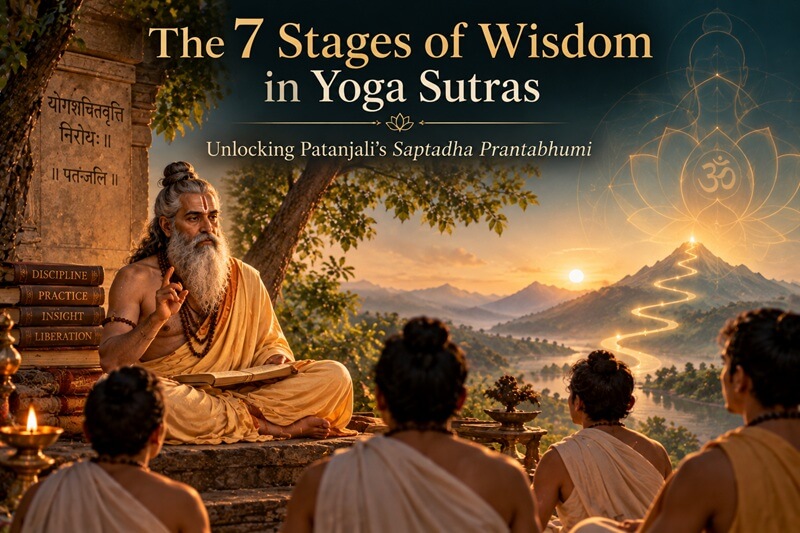
In Yoga Sutra 2.27, Maharshi Patanjali introduces a profound concept regarding the culmination of discriminative discernment (Viveka-Khyati):
“तस्य सप्तधा प्रान्तभूमिः प्रज्ञा”
“For the enlightened practitioner, wisdom unfolds in seven progressive stages.”
These seven stages (Saptadha Prantabhumi) map the transition of human intellect (Buddhi) from worldly delusion to absolute liberation (Kaivalya). Modern commentaries often categorize them into two distinct realms: Karya-Vimukti (liberation from active duties/effort, stages 1–4) and Chitta-Vimukti (liberation of consciousness itself, stages 5–7).
Part 1: Karya-Vimukti (Freedom from Action and Effort)
These initial four stages represent the cognitive clarity gained through active practice (Sadhana).
- 1. Heya Shoonya Avastha (Realization of What to Avoid)The seeker clearly recognizes the nature of suffering (Heya) in the material world. You fully understand what needs to be discarded—ignorance, egoism, attachment, aversion, and fear of death—and no further hidden sources of pain remain to be identified.
- 2. Heya Hetu Shoonya Avastha (Realization of How to Avoid)The root cause of suffering (Heya Hetu), which is the illusionary alliance between the Seer (Purusha) and the Seen (Prakriti), is dissolved. The practitioner has systematically eliminated the causes of delusion, leaving nothing more to destroy.
- 3. Prapya-Prapta Avastha (Attainment of the Supreme Goal)The state of Han-Prapti—the realization that true knowledge has been gained. The search for external truth ends here because discriminative knowledge (Viveka) is fully anchored. There is no higher wisdom left to acquire.
- 4. Chikisha Shoonya Avastha (The End of Duty and Desire)Chikisha means the urge to act or accomplish. In this stage, intellect turns into ultimate wisdom. All spiritual debts and worldly duties are fulfilled (Kritakrityata). There are no remaining actions or practices left to perform for self-realization.
Part 2: Chitta-Vimukti (Freedom of Consciousness)
The final three stages involve the dissolution of the mind’s subtle mechanics, shifting focus from individual effort to absolute absorption.
- 5. Chitta Satya Kritarthata (Awareness of Non-Authority of the Worldly Plane)The mind (Chitta) completes its evolutionary mandate. Consciousness acknowledges that its dual roles—providing worldly experience (Bhoga) and enabling liberation (Apavarga)—are finished. The external world loses its binding authority over the mind.
- 6. Guna Leenata (Dissolution of the Three Gunas)The three fundamental qualities of nature—Sattva (harmony), Rajas (activity), and Tamas (inertia)—recede back into their unmanifest source (Prakriti). The subtle mind dissolves, and its influence over individual identity ceases entirely.
- 7. Atma-Sthiti (Abidance in the True Self)The final state corresponds to Yoga Sutra 1.3 (Tada Drashtuh Svaroope ‘Vasthanam). The pure consciousness (Purusha) rests eternally in its own intrinsic nature, completely detached from the modifications of Buddhi. This is ultimate liberation (Kaivalya).
Here is a summary table for The 7 Stages of Wisdom (Saptadha Prantabhumi) as outlined in Yoga Sutra 2.27:
| No. | Stage Name (Avastha) | Stage Classification | Core Meaning | Classical Realization |
| 1 | Heya Shoonya Avastha | Karya-Vimukti (Action/Effort Liberation) | Realization of what to avoid | Suffering (Heya) is fully understood; nothing more remains to be recognized as painful. |
| 2 | Heya Hetu Shoonya Avastha | Karya-Vimukti (Action/Effort Liberation) | Realization of how to avoid | The causes of suffering (Heya Hetu / Ignorance) are dissolved; nothing remains to be destroyed. |
| 3 | Prapya-Prapta Avastha | Karya-Vimukti (Action/Effort Liberation) | Holding on to Right Knowledge | Discriminative knowledge (Viveka-Khyati) is attained; the ultimate goal is reached. |
| 4 | Chikisha Shoonya Avastha | Karya-Vimukti (Action/Effort Liberation) | Intellect turns into Wisdom | All spiritual and worldly duties are completed (Kritakrityata); no actions remain to be done. |
| 5 | Chitta Satya Kritarthata | Chitta-Vimukti (Consciousness Liberation) | Awareness of non-authority of the worldly plane | The mind (Chitta) completes its purpose; the material world loses its binding grip. |
| 6 | Guna Leenata | Chitta-Vimukti (Consciousness Liberation) | Dissolution of the Gunas | The three qualities (Sattva, Rajas, Tamas) merge back into Prakriti; subtle mind dissolves. |
| 7 | Atma-Sthiti | Chitta-Vimukti (Consciousness Liberation) | Experience of inner divinity / Self-Realization | Pure consciousness (Purusha) abides eternally |
Key Takeaway for Practitioners
Patanjali’s sevenfold wisdom is not just a theoretical framework; it serves as a spiritual compass. By recognizing where your intellect currently sits—whether you are still identifying what causes suffering (Stage 1) or moving toward freedom from mental drives (Stage 4)—you can navigate your path with clarity and conviction.

